
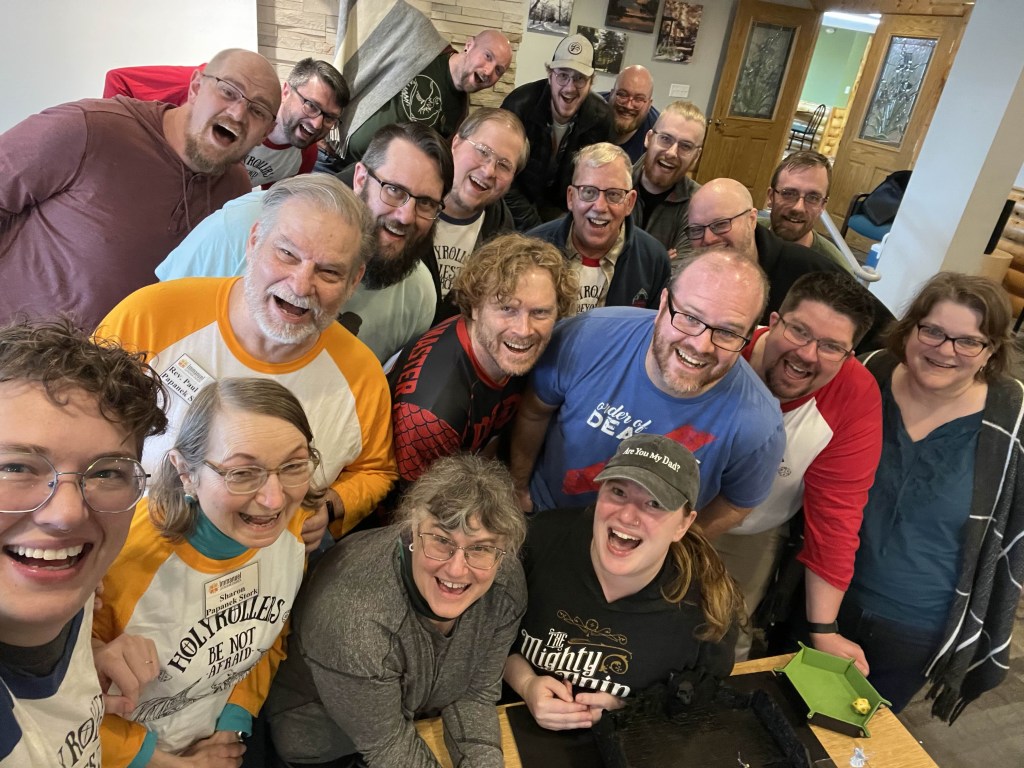
An Invitation to Holy Rollers 2026
There’s something that happens at a table where dice are rolled, stories are made, and strangers become companions in a shared adventure. It’s hard to put into words the first time you experience it. Easier, maybe, to ask a question: when was the last time you played?
Not competed. Not performed. Not checked a box or led a meeting. Played — genuinely, imaginatively, without agenda, the way you did when you were small and the floor was lava and the couch cushions were everything you needed to survive.
That’s the question at the heart of Holy Rollers 2026, and it’s also the heart of our theme: Back to the Cradle.
What Is Holy Rollers?
Holy Rollers is an annual retreat hosted by Roll for Joy (a ministry of Prince of Peace Lutheran Church) that sits at the intersection of tabletop role-playing games, spiritual formation, and ministry leadership. It is part learning laboratory, part spiritual retreat, and part adventure. Over the years, it has welcomed laypeople, pastors, deacons, ministry innovators, seminary staff, bishop’s staff, and churchwide staff from across denominational traditions. Many participants have used it as part of their continuing education and professional development.
If that sounds like an unusual combination — faith, games, and professional learning — well, that’s kind of the point. Holy Rollers exists because the unusual combination turns out to be surprisingly powerful.
One person who discovered that firsthand is Dr. Dawn Alitz, now serving as Assistant to the Bishop in St. Paul. After attending a previous Holy Rollers retreat, she wrote about the experience in a reflection published on Faith+Lead, describing how the West Marches format of D&D play gave her an entirely new lens on discipleship and ministry participation. She observed that the game surfaced something essential: that communities flourish when people move from watching to actively participating, when unique gifts are named and called into mission, and when leadership looks less like project management and more like faithful accompaniment. Those aren’t small insights. And they came through the unexpected classroom of a game.
That’s what Holy Rollers does. It uses the table as a learning environment — one that is playful enough to disarm us and substantive enough to genuinely change how we think.
Back to the Cradle
As adults, we are very good at being useful. We plan, assess, strategize, and lead. We are often less good at something children do effortlessly: imagining things that aren’t yet real, and believing in them anyway.
That capacity — for wonder, for imaginative freedom, for approaching the world as if it might yet be different than it is — doesn’t just belong to childhood. Theologian Jürgen Moltmann writes that “in playing, we can anticipate our liberation and with laughing rid ourselves of the bonds which alienate us from real life.” Jesus himself says that those who want to enter the kingdom of heaven must enter it as a child. That’s not a call to naivety. It’s a call to imagination — to the kind of hope that can conceive of a world not yet realized and work toward it anyway.
This year at Holy Rollers, we’re going back to the cradle. Not to regress, but to recover something. We’ll explore how reconnecting with childlike imagination can become a powerful resource for healing the fractures within ourselves, within our communities, and within our world.
The Learning Sessions: Six Foundational Components
Holy Rollers has always been more than a gaming retreat. This year it’s structured around two primary learning sessions drawn from my research into what I call the Six Foundational Components of Spiritually Applied Role-Playing Games.
These are the six qualities that make tabletop RPGs uniquely suited for spiritual exploration and transformative learning:
Playful. Play is not frivolous — it is formative. Play researcher Dr. Stuart Brown identifies play as something we are literally built for, designed to engage in across our entire lives. In the context of spiritual direction and ministry formation, play opens a safe container for encountering existential themes, pathos, and mystery — things that often feel too heavy to face head-on but become accessible through the lightness of play. Philosopher Friedrich von Schiller put it plainly: a person “is only a complete man when he plays.”
Narrative. We are story-making creatures. Richard Jensen, writing about preaching in a post-literate age, observes that humanity’s earliest theological language was the language of story — and story has never stopped being how we make sense of ourselves and our world. The Gospel of John opens by naming Jesus as the Logos — the Word, the Story, that God is telling humanity. Tabletop RPGs are structured acts of collaborative story-making, and in creating those stories, we come to understand our own.
Scaffolded. SA-RPGs don’t ask you to stare at a blank page. They break the work of storytelling into accessible pieces, building what educators call a “zone of proximal development” — the space between what you can do alone and what you can achieve with the right support. This makes deep creative and spiritual engagement available to a much wider range of people. Paul himself scaffolded his disciples, starting them with milk before more complex nourishment.
Cooperative. In a TTRPG, there are no winners and losers — there is only the shared story. This cooperative structure mirrors the communal nature of spiritual life: the ubuntu principle that “I am because we are.” As Paul writes, some are hands, some are feet, some are eyes — but each belongs to the same body, and none is complete without the others.
Surprising. The dice introduce genuine uncertainty into the story. What happens next cannot be fully controlled. This creates a quality of presence — a mindfulness — that parallels other contemplative practices. It also mirrors the theological reality that, as Jesus says, “the Spirit blows where it chooses.” Openness to surprise is openness to God.
Aesthetically Distanced. Players inhabit characters who are both themselves and not themselves. This “aesthetic distance” creates a remarkable kind of safety: a character can take risks, explore shadows, and engage with things the player might not face directly. And what happens in the character bleeds out into the player. The prophet Nathan used exactly this technique when he brought David face to face with his own sin — through the story of two shepherds, not a direct accusation. The parable creates distance that, at the right moment, collapses.
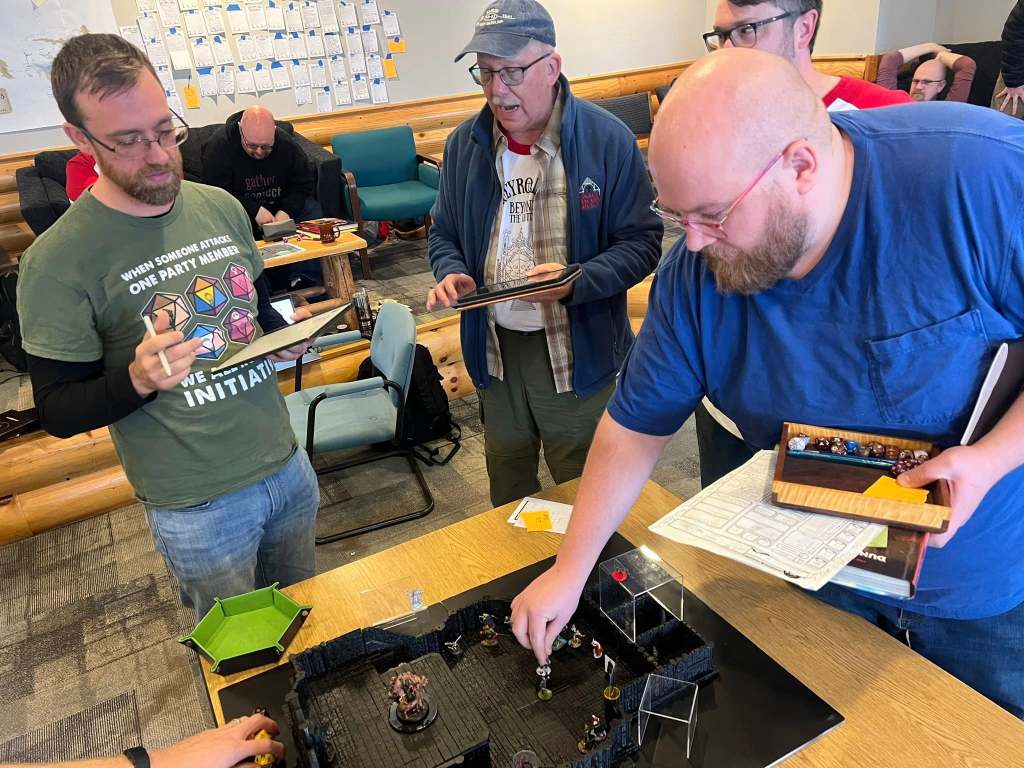
In our learning sessions, we’ll explore each of these components in depth. Then, in our game sessions, we’ll experience them — living out these principles in the collaborative stories we create together around the table.
Who Should Come?
If you are a pastor, deacon, lay ministry leader, ministry innovator, synod or churchwide staff member, or anyone who cares about creative approaches to spiritual formation and faith community — Holy Rollers was built with you in mind. You don’t need any experience with tabletop games. You don’t need to know what a d20 is. You need curiosity, a willingness to play, and maybe the faintest sense that there might be something important on the other side of the table.
Many attendees over the years have counted Holy Rollers toward their continuing education requirements. It is a substantive learning experience — one that also happens to involve rolling dice and telling stories with new friends.
Registration Closes July 15
There is a seat at this table waiting for you.
Registration for Holy Rollers 2026 closes July 15. If you’ve heard about the retreat from someone who has been before, or if you’ve simply been curious about what it means to take play seriously as a spiritual and ministerial practice, now is the time to find out.
The adventure is already being written. Come help tell it.
Roll for Joy exists to explore the surprising places where faith and games meet. Even if you can’t come to the retreat, you can always catch us on the Roll for Joycast wherever you listen to podcasts.



Leave a Reply