
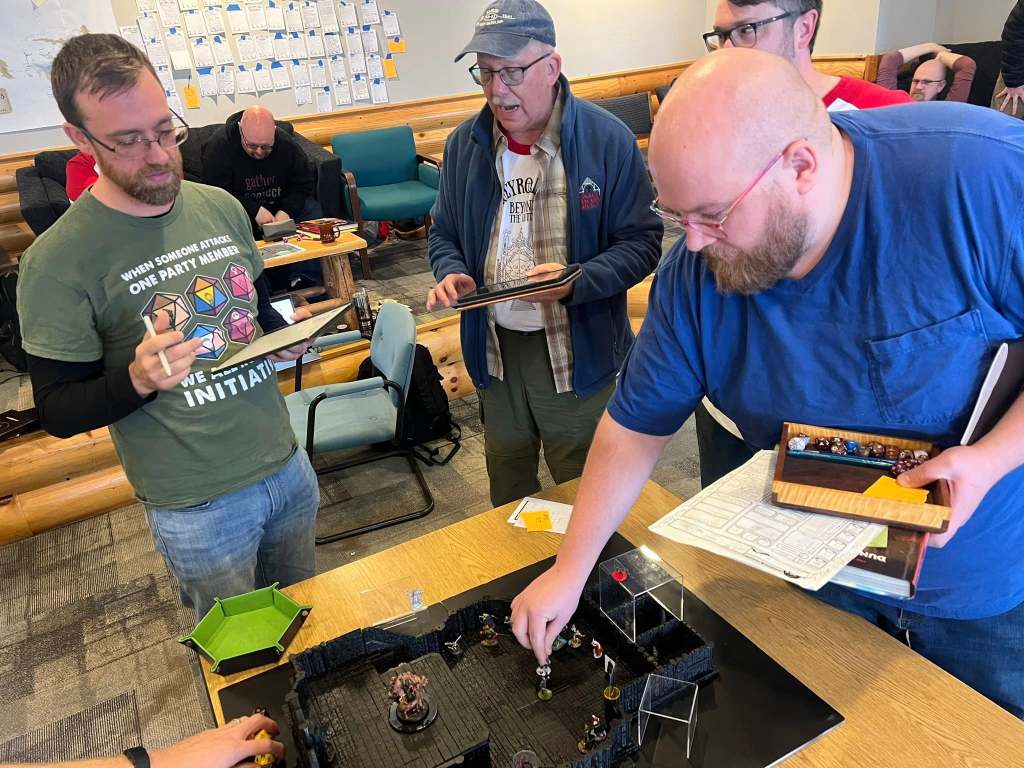
The Sacred Art of the Shared Table
There is a phrase that shows up in a lot of game design spaces, especially in story games and in the kind of thoughtful, human-first design we love: be fans of the characters.
It sounds simple. It isn’t.
As a DM, being a fan of the characters means wanting the characters to succeed even while you plot against them. It’s a tightrope walk and a masquerade. It used to be the ideal for DMs (or ‘referees’ or ‘judges’ as they used to be called) to be completely neutral and impartial. Don’t help the players. Run things as written, no more. But that often led to DMs feeling more adversarial than not as the game became a puzzle to try to guess what the DM or the game designer was thinking. DMs that are fans of the characters are DMs that challenge the players, but also always give their characters enough hints and helps that they are ultimately able to succeed.
As a player, being a fan of the characters applies to you too. It’s important to play your own character fully and fiercely, while also cheering for everyone else at the table to have their moment. It means sharing the spotlight, roleplaying fascination at what other characters are able to achieve, and inviting opportunities for creative in-world collaboration. It means that even when your character is in conflict with another character (irritated, challenged by, competitive with, rivals of) you, the person behind the character, still want them to have the best possible story they can have.
There’s a difference between what your character would do and what your character should do, and that difference is only legible if you’re paying attention to the whole table, not just your own scene.
Some of the worst play I’ve ever experienced happened when a player said, “That’s just what my character would do!” Unfortunately, what the character did damaged someone else’s experience. Cut off someone else’s story. Made someone feel small, or excluded, or not worth protecting.
Role play doesn’t give you a hall pass for cruelty. The freedom of improv does not include the freedom to disregard the people sharing the table with you.
Alex and I talked a bit about playing a tense enemies-to-lovers dynamic at the table. When our characters started out, they were certainly not fans of each other. There was real ideological friction, competition, and antagonism between them. But as Alex and Rory, the people behind those characters, we never stopped knowing that we were friends. We were rooting for each other. We were making space for each other’s moments even as our characters tried to undercut each other’s plans. The character conflict was able to be so rich because the player relationship between us was safe.
That is the irreplaceable ingredient: a table where the people trust each other.
Anthony talked about building that trust intentionally. He runs online games because of his disability, with groups who start as strangers. The groups that stay together, he said, are the ones that end up having conversations outside the game. Where one player knows something about another player’s hard week and quietly tells the DM, “Hey, they’re going through something, it’s okay.” It’s a special thing when people become human to each other before the dice ever hit the table.
That kind of community doesn’t happen automatically. It has to be built.
Which means: introduce yourselves. Not just your characters — yourselves. Ask the before-game question that lets people say something true. Share your pronouns. Use safety tools (like our favorite tool, Script Change, where you can press pause, stop, fast-forward, or rewind) so that everyone knows the game is genuinely a safe space to take risks. Check in after the session. Not just, “Did you have fun?” but “Is there anything we could do better?” It’s vulnerable to play, even when you don’t realize it, you are in there. The character is carrying something of yours.
And then… once the safety is there, once the trust is built… the magic that can happen is extraordinary.
Anthony told a story of a paladin at a convention who, when the party was overwhelmed and fleeing through a choke point, stopped. Turned. Said to her party over her shoulder, “I’ll hold them off as long as I can. Run.” And then she stood there, cutting down orc after orc, buying her companions ten rounds of escape. It was not tactically optimal. It was not even narratively inevitable. It was just who that character was, expressed in the highest possible register.
That story, Anthony said, came from Gary Gygax himself, watching a tournament, watching a player make a choice that was completely in character, completely generous, completely for the good of everyone else at the table.
That is what being a fan of each other makes possible.
The Apostle Paul (yes, we’re bringing him to the table) told the community at Corinth something that applies here, “Love does not insist on it’s own way.” It’s patient. It considers the other. It doesn’t weaponize freedom.
The table at its best is a community. Not a collection of competing heroic monologues, but a place where stories rise and fall together, where the moments that matter most are the ones that belong to the whole room.
So bring your character fully. Play them fiercely. Let them be complicated and flawed and surprising.
And then be a fan of everyone else doing the same.
Journey together. Find the fun. Hold on to hope.
This is part 4 of a four-part series drawn from Episode 6 of the Roll for Joycast, where Alex Smith (Role Play Paladin), Anthony (Battlemap Boss), and Rory (the DM Pastor) explored the art of improv and storytelling at the table. New episodes of the Joycast come out monthly — find the Roll for Joycast on YouTube or wherever you get your podcasts. If this post got your creative juices flowing, post a comment or send us a message! And if you’re feeling the itch to play in person, the Holy Rollers Retreat is coming in August 2026 — use the code JOYCAST for early bird pricing.



Leave a comment