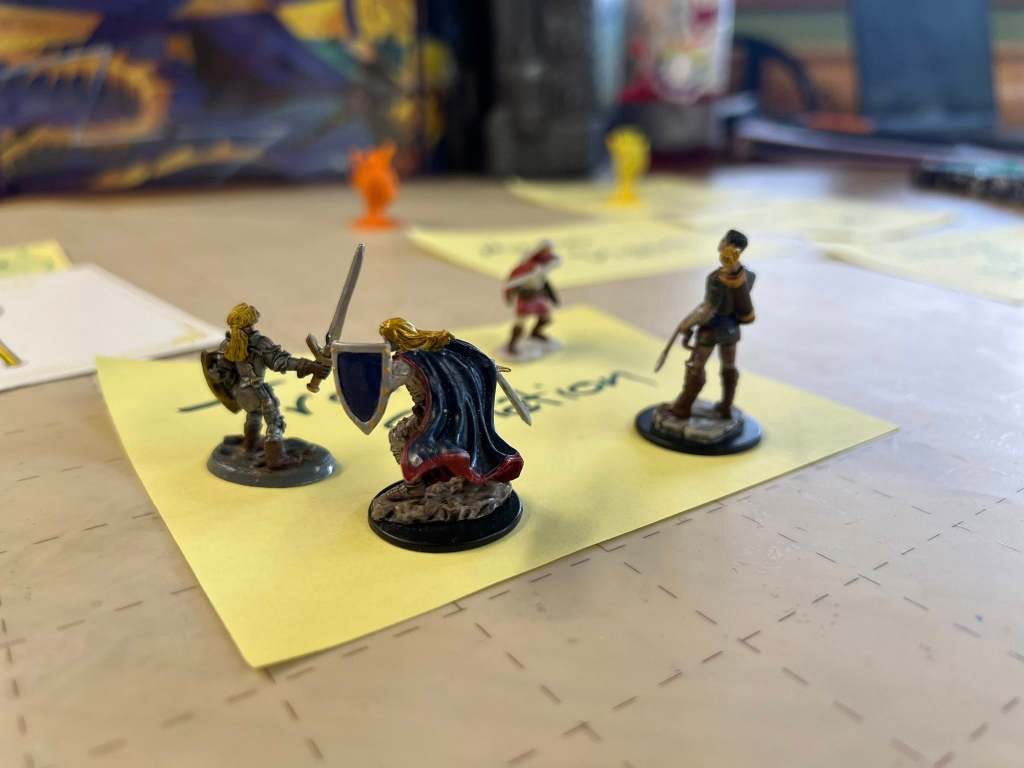
There’s a moment at the table. Maybe you’ve felt it. The dice clatter. Everyone looks up. And instead of answering as yourself, you answer as someone else… someone you invented, someone you’re still figuring out, someone who just surprised you.
That’s role play. That’s what we’re chasing.
But getting there takes a little groundwork first. Not a 20-page backstory. Not a perfectly optimized stat block. Just a structure, a few load-bearing walls, and then the freedom to let everything else grow wild.
On a recent episode of the Roll for Joycast, our co-host Alex, the Role Play Paladin, put it this way: you need to create a head before you can walk anywhere interesting. A foundation. A template. A handful of things you know to be true about your character. Once you have that, all the rest (the beauty, the surprise, the depth) gets created at the table.
So where do you start?
Start with a motivation. A character who doesn’t want to be in the room is just a weight everyone else has to carry. Your character doesn’t have to be heroic. They don’t have to be noble or good or even likeable. But they have to want something. Take the merchant in a chicken costume. (Yes, this is a real character someone once brought to the table. His name was Mario de Bonanza, and he was the mascot of his family business.) He wanted nothing more than to promote the family brand. That’s all. But that absurd, earnest, ridiculous drive gave him life. Gave him a voice. Made the whole table lean in.
Start with an emotion. Not a trait. An emotion. If the motivation is the engine, the emotion is the weather. Eager and silly. Righteous and guarded. Hungry and sad. You know when you’ve found the right one because it changes how you walk, how you talk, how you hold your body, how you react when the plan falls apart.
Start with a flaw. This is the part we skip, because we don’t like to fail. But there is no interesting story without something breaking. The character who tries to be good at everything is good at nothing. Alex described building their first character that way. In trying to keep all their numbers even, they wound up being unable to hit, unable to help, unable to do much of anything. Min-max your character. Lean into something. Let something else sag. That tension between the boon and the bane — what you’re good at, what causes you trouble — is where the story actually happens.
There’s a simple framework worth borrowing: Bane. Boon. Bond.
What’s the thing that causes your character trouble? What’s the thing they’re genuinely gifted at? And who do they care about or who has shaped them in a way that drives their choices? You don’t need more than this. You don’t need to resolve the tension between these three things before you sit down to play. The tension is the character. Let the play be the resolution.
One more thing. (And this one can go deep enough to become spiritual if you want it to be.) No matter how different you build your character from yourself, part of you is going to come through. Anthony talked about playing a 13-year-old version of himself in a Cthulhu-tinged 80s mystery and finding it one of the best games of his life. I played a villain who was arrogant, reckless, haughty, and naughty, and found that I had more in common with her than I wanted to admit.
This is not a problem. This is the gift.
When we put on a character the way we might put on a costume, we don’t disappear. We show up differently. We find our edges. We practice being someone whose pain we haven’t yet learned to feel, and we learn to feel it. We are made, as Genesis tells us, in the image of a creating God. And when we play — when we co-create at the table with dice and voices and imagination — something of that image gets expressed.
So build your structure. A motivation. An emotion. A flaw. Three things that sit in tension with each other. And then show up to the table ready to be surprised by who you become.
This is part 1 of a four-part series drawn from Episode 6 of the Roll for Joycast, where Alex Smith (Role Play Paladin), Anthony (Battlemap Boss), and Rory (the DM Pastor) explored the art of improv and storytelling at the table. New episodes of the Joycast come out monthly — find the Roll for Joycast on YouTube or wherever you get your podcasts. If this post got your creative juices flowing, post a comment or send us a message! And if you’re feeling the itch to play in person, the Holy Rollers Retreat is coming in August 2026 — use the code JOYCAST for early bird pricing.



Leave a comment