Let that sink in for a moment.
Forty years ago, churches across America were hosting bonfires. Parents were panicking. Youth pastors were preaching sermons about the dangers of dice. Dungeons & Dragons was declared a gateway to the occult, a tool of Satan, a one-way ticket to spiritual ruin, and the books were thrown into the flames.
Today, Roll for Joy is featured in Living Lutheran, the official magazine of the Evangelical Lutheran Church in America, where we are celebrated as a ministry of community, spiritual formation, and radical welcome.
That is some change. And we are here for it.
A Brief History of Moral Panic
If you weren’t alive for the Satanic Panic of the 1980s and early 90s, it’s worth pausing to appreciate just how wild it got.
D&D — a game in which people sit around a table, eat snacks, and collectively imagine themselves as fictional heroes on fictional adventures — was treated as an existential threat to Christian America. James Dobson’s Focus on the Family produced warnings about it. Pat Robertson railed against it. Jack Chick published tracts claiming that the game taught real witchcraft and summoned actual demons. Respected journalism outfits like 60 Minutes ran stories on the evils of Dungeons & Dragons. Books were burned. Games were confiscated. Kids were sent to counselors to be deprogrammed from their interest in elves.
The game was, to be clear, always just a game. A creative, collaborative, imagination-expanding game about storytelling and community. But fear is a powerful thing, and in that cultural moment, the dragon on the cover of the Monster Manual looked a lot more threatening than it was.
What Actually Happens Around a D&D Table
Here’s the scandalous truth about what happens when people play Dungeons & Dragons:
They listen to each other. They take turns. They make decisions together. They practice imagining what it feels like to be someone else — someone with a different background, a different body, a different set of gifts and wounds and experiences. They face hard choices in a safe space. They fail, and try again, and discover that failure isn’t the end of the story.
They build community.
Which is, as it turns out, exactly what the church has always been trying to do.
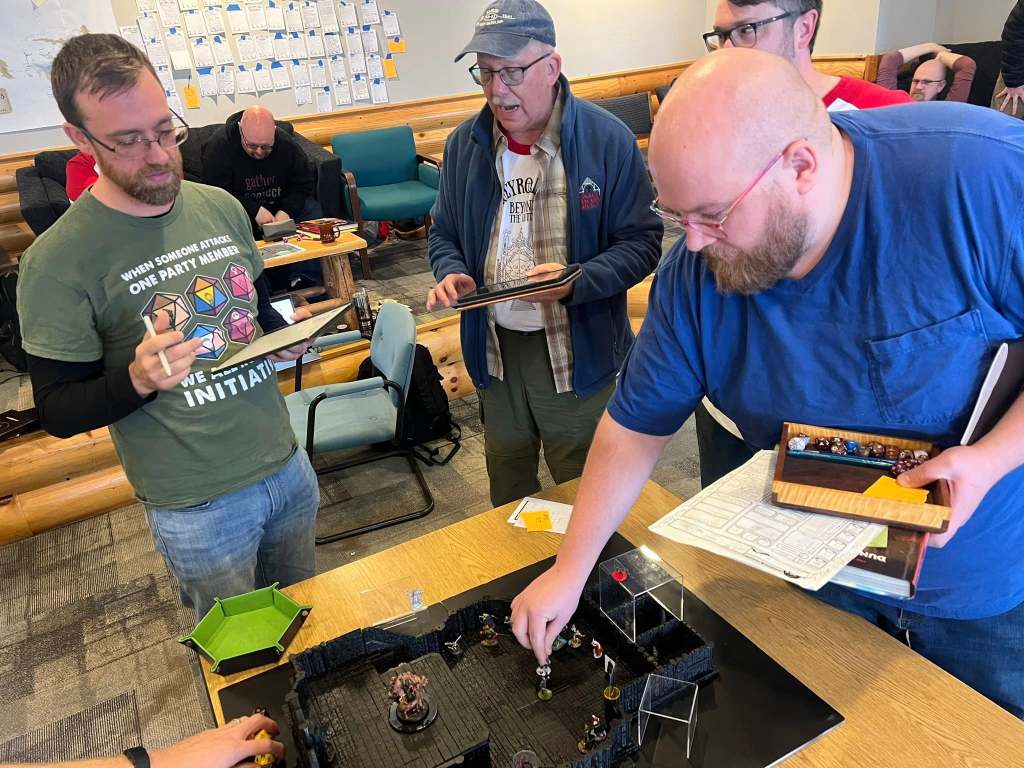
Ben and I saw this clearly when we gathered a group of rural pastors around a D&D table back in 2015. What started as clergy having fun with dice became something unmistakably sacred. It became a space where people showed up fully, laughed hard, and experienced genuine fellowship. From that table grew the Pastors & Dragons Retreat, which grew and turned into the Holy Rollers Retreat, which grew and became grew Roll for Joy: a multi-pronged ministry project providing D&D resources, regional meetups, and community for adventurers of faith from across the country and around the globe.
The demon-summoning never materialized. The community absolutely did.
The ELCA Puts It in the Magazine
The spring 2026 issue of Living Lutheran features Roll for Joy in a piece called “Holy Rollers” — and it doesn’t treat us as a curiosity or a quirky footnote. They put us on the front page of the print edition! This is a story that takes seriously the theological claim at the heart of this work: that D&D is, in the words of the pastors and ministry leaders featured, a holy experience.
The article explores how tabletop games build empathy, expand imagination, and open doors for people who never saw themselves in a church community before. It lifts up the truth that if your imagination is limited, your encounter with Scripture will be too. It recognizes that rolling dice and engaging around a shared story is surprisingly good practice for the kind of imaginative, embodied faith that Lutheran theology has always affirmed.
The churches that burned these books were afraid of imagination. Roll for Joy is betting everything on it.
How Far We Have Come
We don’t say this to mock anyone who was or is still afraid. (We continue to get emails from folks wrestling with family members, friends, or religious figures in their lives telling them that this game is bad or evil somehow.) Fear is real, and cultural moments have a way of making the harmless look monstrous. But we do want to name the distance we’ve traveled. Change is afoot, and it matters.
From bonfires to feature articles. From “this game will destroy your soul” to “this game might save your ministry.” From confiscated rulebooks to pastors who are ordained Dungeon Masters.
That is a remarkable journey. And it is, we would argue, a story about the church at its best, a community of people coming together to learn how to recognize the sacred in their midst, especially in places unexpected. It’s been a slow learning, and sometimes a painful one, but I am glad to be a part of a church that continues learning. Learning that joy is not a threat to faith. Learning that the table is bigger than we thought.
Jesus, after all, was notorious for sitting at tables, hanging out with all the wrong people.
Come Roll With Us
If this story resonates — if you’ve ever loved something the church told you was dangerous, or if you’ve ever felt like there wasn’t a seat for you at the table — we want you to know: there is one here.
Roll for Joy exists for exactly that person.
- Read the full feature: Holy Rollers | Living Lutheran — and launch the visual story for photos from our recent events. You’ll want to see them.
- Learn more about our annual retreat: Holy Rollers Retreats | Roll for Joy – there’s still time to register to come along! Part gaming convention, part continuing education, part hanging out with some of the best people you can find – this retreat is a one of a kind experience.
- Check out the latest podcast episode: Rolling with MS – Roll for Joycast: Episode 5
- Support our work on Ko-fi: Roll4Joy | Ko-fi – your donation helps us keep going in our work of creating healing community around tabletop gaming.
The books didn’t burn. The game didn’t summon any demons. But it did build something that looks, to us, a lot like the kingdom of God.

 Roll for Joy
Leave a comment