
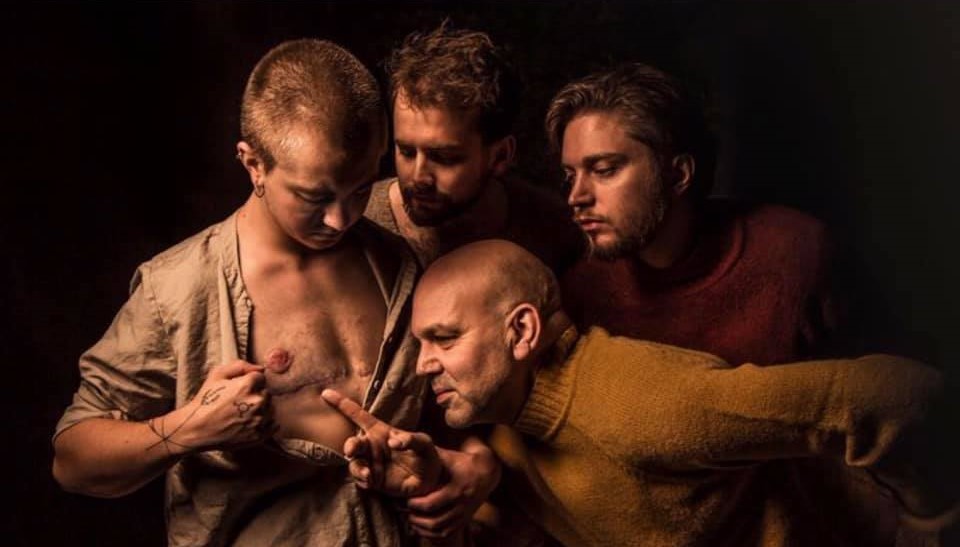
Given that a number of politicians, including our former president, said today that celebrating day as the Trans Day of Visibility is an assault on Christianity, I feel that it is important as a Christian to say a bit on this Easter night about why supporting trans people and celebrating trans joy is not only good, but godly.
Last fall, I had the joy of leading a group through a book study of Austen Hartke’s amazing book Transforming: The Bible & the Lives of Transgender Christians. Here’s what we learned.
Sobering Statistics of Real Human Need
This should come as no surprise, but being trans is a pretty difficult identity to carry. Trans people often face discrimination in all corners of life.
- 41 percent of transgender adults have attempted suicide. (The overall rate for the general population is 1.6%) according to the 2014 National Transgender Discrimination Survey
- 90% of transgender people have experienced harassment or discrimination at work
- 57% have experienced significant family rejection
- 26% have been fired for being transgender
- 19% have experienced homelessness because of their gender identity
- This number jumps from 41% to 59% among those who were harassed at work, up to 61% among those who were harassed by law-enforcement, and 78% among those who experienced physical or sexual violence
These numbers are high not because there’s something inherently wrong with them, but because they experience a phenomenon called “minority stress.” Minority stress describes the friction that occurs between a person who holds a marginalized identity and the hostile environment in which they live. Transgender people live with a continuous expectation of rejection, and many experience an endless underlying current of fear because of the threat of physical or emotional violence.
Relieving minority stress by supporting trans people has real life or death consequences. While over half of LGBTQI2A young people who were rejected by their families reported having attempted suicide, compared to only 32% of those who had supportive families.
Apologetics for the “Clobber Passages”
A lot of people point to passages from the Bible as justification for discriminating against trans people. But those passages need not be interpreted in ways that encourage discrimination and are so much better when they are read through a more compassionate and expansive lens.
- Genesis 1
- God created marshes, twilight, and platypuses, as well as intersex and transgender people. In the same way we call God the Alpha and the Omega, implying all things from first to last and in between, the author of Genesis 1 is merely using the same dualistic poetic device to corral the infinite diversity of creation into categories we can easily understand.
- Genesis 19:1-38
- The punishment wrought upon Sodom and Gomorrah has nothing to do with consensual sexual relations; the sins of Sodom are inhospitality, threat, and finally, attempted rape. Should this point not be clear, Ezekiel makes it so. Ezekiel 16:49 reads, “This was the sin of your sister Sodom; she did not support the poor and needy.”
- Deuteronomy 22:5
- The word here translated as “abomination,” is also used in Deuteronomy to describe eating pork and shellfish, bringing images of other deities into your home, a man remarrying his ex-wife, and a business owner who commits financial fraud, among other things. What is truly driving our choices about which passages of Scripture to hold on to most closely?
- Romans 1:25-27
- What Paul thinks of as nature we today think of as culture. Nature does not prove that same-sex relations are unnatural, for the non-procreative is not the same thing as the non-natural. Nor are same-sex relations absent from more than 1,000 non-human animals, including sheep, female bottlenose dolphins and lions.
- 1 Corinthians 6:9-11, 1 Timothy 1:9-10
- These lists both contain the Greek word pornoi, where the English term “pornography” comes from, and have something to do with improper sexual behavior. The standard English translation is “fornicator,” although other versions use “sexually immoral”. The problem: Definitions of what is sexually improper change over time. Prostitution? Sex out of wedlock? Flirting? A woman showing her ankle? A kiss?
- Other words in these lists are malakoi, asenokotai, and adrapodistais. Holding all these terms together, we see a description not of consenting relationships, but to human trafficking – coerced, commercial sex transactions: the “fornicator” who is interested in procuring an enslaved boy or man, the pimp or head of a brothel who provides the boy or man, and the enslaver who sold the boy or man in the first place.
- Jude 6-7
- The story from Genesis 19 about Sodom and Gomorrah, which is referenced here, is about the attempted rape of strangers, who are, in fact, angels. Jude reverses the motif, for it alludes to angels who are engaging in inappropriate relations with women. For Jude, the issue is divine-human coupling, which is contrary to the nature of angels, who are, as Jesus puts it, neither married nor given in marriage (Matthew 22:30; Mark 12:25; cf. Luke 20:35). The text has nothing to do with queer sexualities or sexual identities.
Scriptures of Welcome
Instead of just focusing on arguing against unfortunate interpretations of scripture, it’s life giving and deeply rewarding to pay attention to other passages of scripture that give life and speak of expansive support of trans and queer people.
- Genesis 1:26-27
- God created marshes, twilight, and platypuses, as well as intersex and transgender people. In the same way we call God the Alpha and the Omega, implying all things from first to last and in between, the author of Genesis 1 is merely using the same dualistic poetic device to corral the infinite diversity of creation into categories we can easily understand.
- On God creating humanity in “our image” – notice the plural possessive used here. Our experiences of other parts of our identity are multifaceted and generally non-binary. Gender isn’t necessarily a “this” or “that”, or even a linear spectrum. In other words, it’s not just pink or blue, female or male – it’s also yellow, orange, brown, sparkles, or plaid. As Bob Dylan sings, “I contain multitudes.”
- Isaiah 56:1-8:
- In Deuteronomy eunuchs and foreigners are prohibited from entering the Temple, but God is alive and active in our world, working for the good of all people, even going so far as to change or break sacred rules to make sure everyone is included.
- Matthew 19:11-12
- Jesus chooses eunuchs – the most prominent gender-expansive people in his time and place – as an example of faithful discipleship outside cultural norms. Jesus says there are three types of eunuchs, and modern scholars have connected the first type to people who are born with differences in sex development or attraction to others, and the second type to people who were assigned male at birth but who were castrated by people in power. The third group – “eunuchs for the kingdom of heaven” – may be a reference to people who expressed their gender in ways that were countercultural as part of both their identity and their faith.
- Luke 15:4-7
- Sheep will occasionally pick out a flock member who doesn’t fit in – maybe because of an injury or a strange marking – and they’ll chase that individual away. Christians have been driving LGBTQI2A people away from the church for decades – and then asking why they won’t come back and repent. But Jesus, as the Good Shepherd, leaves the ninety-nine sheep behind to go in search of the one who needs help. Any economist will tell you the shepherd should cut his losses and move on! But Jesus shows us a bigger truth about the greater good. When Jesus goes after the lost sheep, he’s telling the flock that as a community, we need each other to be complete.
- Acts 8
- For the eunuch this encounter ends in incredible, nearly unbelievable joy. But despite the inner transformation that baptism brings, some things stay the same. For instance, the eunuch is still a eunuch; baptism did not change his physical body or anything about his gender. None of the things that made him an outsider in the first place have been changed or “fixed.” The eunuch “went on his way,” continuing on the same path he’d been on when Philip first found him.
- Galatians 3:26-28
- The early church had intense debates about circumcision, the status of slaves, and women in leadership. So many of Paul’s letters to the first-century churches focus on those debates, as the apostle mediated between different factions asserting that they knew the best way to follow Christ. This scripture is a powerful testament to unity. But oneness does not mean sameness. God’s full and vibrant kingdom is made up of beloved creations, each uniquely made in the image of God, and is a place where our differences are an asset, not a source of anxiety and division.
- Other Biblical Heroes Who Transcended Gender Binaries
- Joseph – wore the same long-sleeved robe as the king’s virgin daughters.
- Deborah – a wife and mother who led her people in politics and warfare.
- Daniel, Shadrach, Meshach, and Abednego – most likely made eunuchs when put into the service of King Nebuchadnezzar, were under the charge of the “chief of the eunuchs”.
Expansive welcome is good, Biblical, important, and potentially life-saving.
So see, celebrate, and support the trans people in your life!
It seems a lot of people get hung up on the language changes that are a required part of that support, pronouns and such. Yes, the language can feel complicated at times. So let me leave you with two general rules to keep in mind on this:
Rule 1: While it can feel comforting to have strict definitions for words that are the same always and everywhere, the truth is that language is constantly changing.
As we discover new things about the universe and about ourselves, new words are created, and as we learn more about those discoveries, the definitions shift in order to become more accurate or to make sense in different contexts.
Rule 2: Always prioritize the person standing in front of you.
If you watch a documentary, attend a workshop, or read a book or a blog post (including this one!) that gives you one definition for a word or identity, but then you meet someone in your life who holds that identity but understands it differently, don’t try to correct them. That person understands their own identity better than anyone else, and it’s a gift to be able to learn from them.
If they have a nuance to their identity that’s different from how you understand or experience it, that’s OK. In fact, it’s beautiful.
Trans lives are beautiful. Trans joy is beautiful. Trans people are beautiful. The diversity of this world and the breadth of human experience is beautiful. Celebrate that today!



 Roll for Joy
Leave a comment